
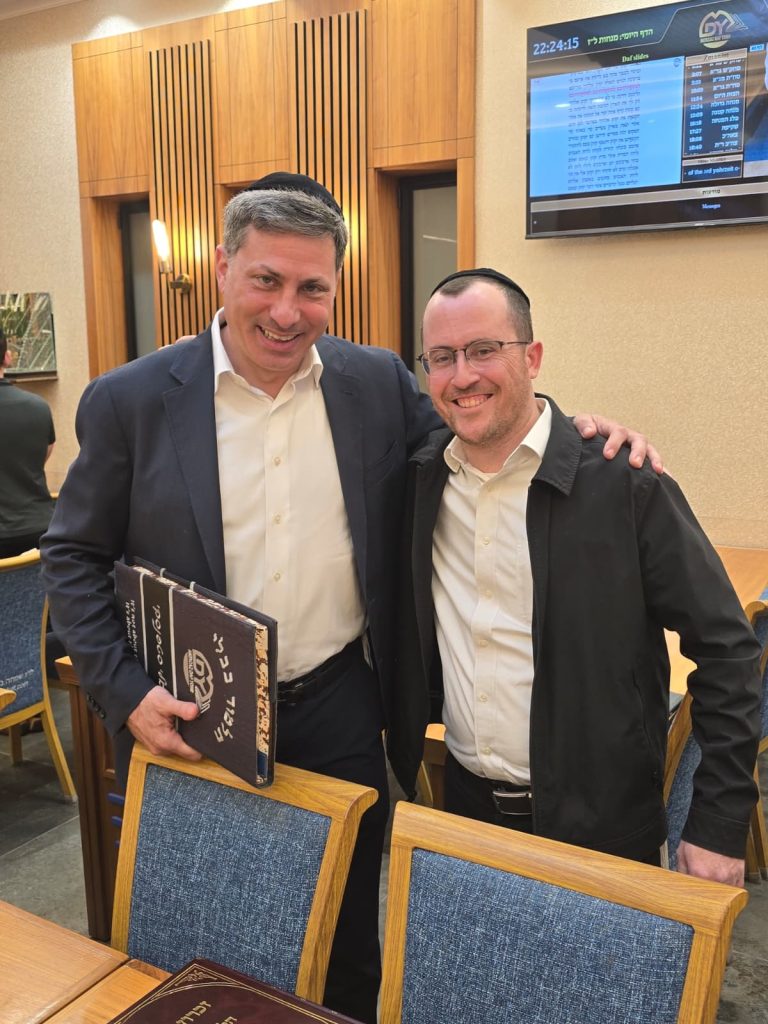
He arrived at Rabbi Eli Stefansky’s home in Beit Shemesh as a professional—armed with his tools and carrying difficult childhood memories from the classroom. He had no idea that there, among the locks and doorframes, he would encounter a different kind of rabbi—one who ignites the light of the Gemara in people’s hearts. Zechariah recounts how he encountered the rabbi in the most personal moments within his home and how a deep connection formed between them.
There are moments when a profession meets the soul. For Zechariah, a locksmith by trade, his encounter with Rabbi Eli Stefansky, founder of the MDY learning empire, did not begin in a crowded study hall or through a viral YouTube broadcast. It began on the threshold of the rabbi’s private home. Zechariah had been invited to install locks, but what he found inside was far more than locking mechanisms—he discovered a figure who managed to unlock a barrier he had carried for years.
“I had heard about Rabbi Stefansky before, but it didn’t really speak to me,” Zechariah recalls candidly. “I came to his house to do a job, and naturally, in someone’s home you meet them in their most ordinary moments. The rabbi ‘fell on me,’ in the best sense of the phrase. He simply looked at me and said, ‘I’m giving a shiur—come.’ I tried to dodge it, to explain that I was busy, but there was something in his energy, in the way he sees people, that didn’t allow me to say no.”
Working in the rabbi’s home allowed Zechariah to glimpse layers that most students never see. “I saw authenticity,” he says with emotion. “People know that the rabbi gave up a comfortable life in the United States to devote himself to Daf Yomi, but seeing it with your own eyes is different. I saw his ‘cave’—the small room on the balcony where he shuts himself away for hours on end. His schedule is simply unimaginable. Everything is dedicated to preparing the daf, to perfecting every animation and every explanation. He gives up his comfort and his time in a way that is deeply inspiring—it leaves you with no excuses.”
For Zechariah, who describes himself as someone who struggled academically and never quite found his place, this discovery was pivotal. “I studied in yeshivot, but there was always difficulty. When I was a child, a rosh yeshiva once told me that if I didn’t buy my own Gemara it probably meant it didn’t interest me. That hurt me for years. Today I can laugh about it because I understand where the barrier came from. Today attention disorders are recognized and treated, but back then it was a heavy burden for everyone—especially for rabbis who wanted to give you so much, while you simply couldn’t receive it. In Rabbi Stefansky’s home I saw something different: a rabbi who uses technology, animation, and humor to make Torah accessible to people like me.”
That personal encounter in the rabbi’s home led Zechariah to make a courageous decision. That Thursday, when he finished the job and took the elevator down to his car, he felt it was a moment of “now or never.” He canceled his evening jobs, and since then he has become an integral part of the shiur in Nachal Noam in Beit Shemesh.
“That shiur saved me,” he admits. “My entire day has changed. I used to work from nine in the morning until nine at night and feel like I didn’t even have time to breathe. Now I come home at seven, spend time with the kids, and then head out to the shiur. And amazingly, my day suddenly feels like it has 28 hours. I have more time for my family, and the conversations at our Shabbat table have completely changed. My children see a father who enjoys learning, and they themselves already want to join.”
In conversation with Zechariah, he also describes other aspects of the rabbi’s personality, such as his extraordinary social sensitivity. He recalls how the rabbi, despite his overwhelming schedule, responded to his request and went to comfort a mourner—a lonely individual who had returned from abroad. “He sat there and gave that person the feeling that he was the most important person in the world. He reads people. During the shiur, in front of eighty participants, he knows exactly who the shy guest is and who needs a kind word. He’s not just a rabbi—he’s a psychologist of the soul.”
The story of Zechariah the locksmith is a reminder that sometimes, to open a locked door in the heart, sophisticated tools are not required. One encounter with a person who truly lives what he teaches—with selfless devotion and genuine love for fellow Jews—is enough. “I regret that I didn’t discover this path earlier,” he concludes, “but thank God—the lock has finally been opened.”